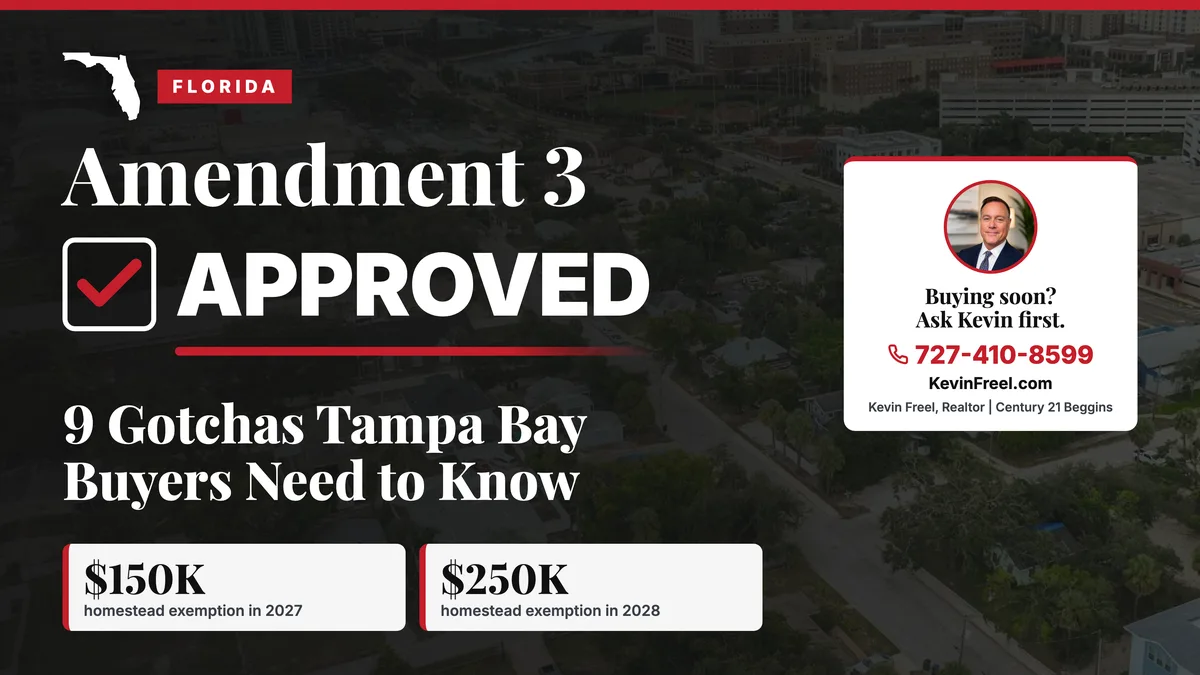
Florida voters made a big decision on November 3, 2026. Amendment 3 passed with approximately 62% of the vote, bringing some of the most significant changes to Florida property taxes in years.
For many homeowners, that’s welcome news. A larger homestead exemption could mean thousands of dollars in annual property tax savings.
But I’ve been selling real estate throughout Tampa Bay since 1985, and one thing I’ve learned is that the headline never tells the whole story.
This amendment has some fine print, and if you’re buying a home in South Tampa, St. Petersburg, Clearwater, Dunedin, or anywhere in the Tampa Bay area, you need to understand it before making an offer.
All nine gotchas in about a minute.
Here’s a question that gets right to the heart of it.
If you purchase a home in December 2026 and establish your permanent residence before the end of the year, you may qualify for the larger exemption in 2027.
But what if you close on that same home in February 2027?
Your own homestead exemption generally won’t begin until 2028.
And what if you’re moving here from another state for the first time in 2027? You could face a much longer waiting period before receiving the expanded exemption.
Those differences can have a real impact on your homeownership budget.
Let’s walk through what passed, what it means for Tampa Bay homeowners, and the important details I’d want every buyer to understand.
What Is Florida Amendment 3, and What Changes in 2027?
Florida Amendment 3 increases the amount of a qualifying primary residence’s assessed value that is exempt from non-school property taxes.
Before the amendment, Florida’s standard homestead exemption provided approximately $50,000 in exemptions for non-school property taxes, subject to the existing exemption rules and inflation adjustments.
The new amendment raises that exemption significantly.
Here’s the schedule:
- 2027: The exemption increases to $150,000 of assessed value for eligible homeowners.
- 2028: The exemption increases to $250,000.
- 2029 and beyond: The larger exemption adjusts annually for positive inflation.
These amounts apply to non-school property taxes. The existing $25,000 homestead exemption for school property taxes remains.
Let’s use an example.
Imagine you own a home in Tampa with an assessed value of $400,000.
Under the expanded exemption in 2028, a qualifying homeowner could have:
| Non-school taxes | School taxes | |
|---|---|---|
| Exempt | $250,000 | $25,000 |
| Still taxable | $150,000 | $375,000 |
That’s a substantial reduction in the amount subject to county, city, and applicable special district taxes.
However, the actual dollars saved depend on the local property tax rates and any other applicable exemptions.
And here’s the first important distinction: the exemption applies to assessed value, not necessarily your home’s purchase price or current market value.
That becomes especially important when purchasing a home from someone who has owned it for decades.
Gotcha #1: The December 31, 2026 Florida Residency Deadline
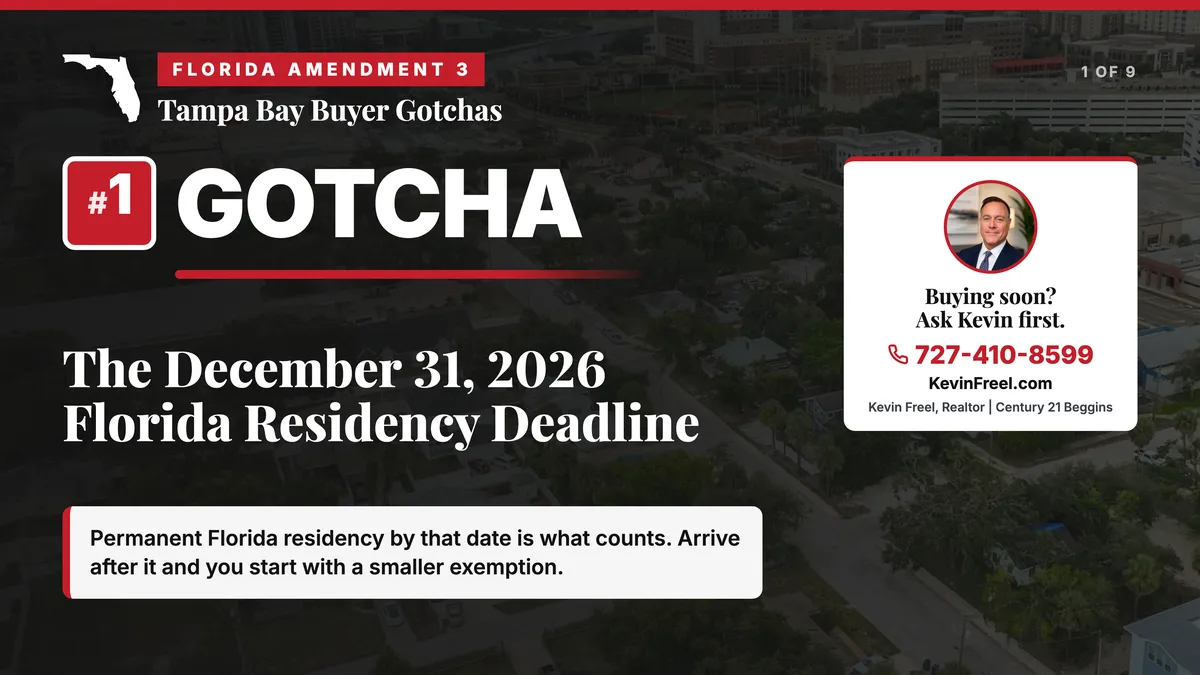
This may be the biggest surprise in the entire amendment.
To qualify for the expanded homestead exemption without the new-resident waiting period, the amendment distinguishes between people who maintained a permanent Florida residence as of December 31, 2026, and those who established Florida residency afterward.
Read that carefully.
The key date is December 31, 2026, and the requirement concerns permanent Florida residency. It does not simply require that you purchased a home before that date.
For example, suppose you’ve rented an apartment in South Tampa for the last three years.
You decide to purchase your first home in April 2027.
Although you didn’t own a home before December 31, 2026, you were already a permanent Florida resident before the deadline. Under the amendment’s residency distinction, you can qualify for the larger exemption when your new home becomes eligible for homestead.
Now consider someone relocating from New York to Tampa in April 2027.
That person wasn’t a permanent Florida resident by the December 31 deadline.
Even if they purchase an identical home next door, their initial homestead tax treatment could be different.
The amendment provides a smaller exemption for new Florida residents until their fifth year of homestead exemption eligibility.
That’s a distinction buyers need to understand before calculating what their new Florida home will actually cost.
One more thing: Simply having a Florida mailing address or signing a contract doesn’t establish permanent residency. Property appraisers consider evidence of your actual permanent home, including documentation such as driver’s licenses, voter registration, prior residency, and other records.
If you’re moving to Florida near the end of 2026, don’t assume a closing date or a piece of paperwork automatically satisfies the residency requirement.
Gotcha #2: Buying in December 2026 Versus January 2027 Can Affect Your First Year of Homestead
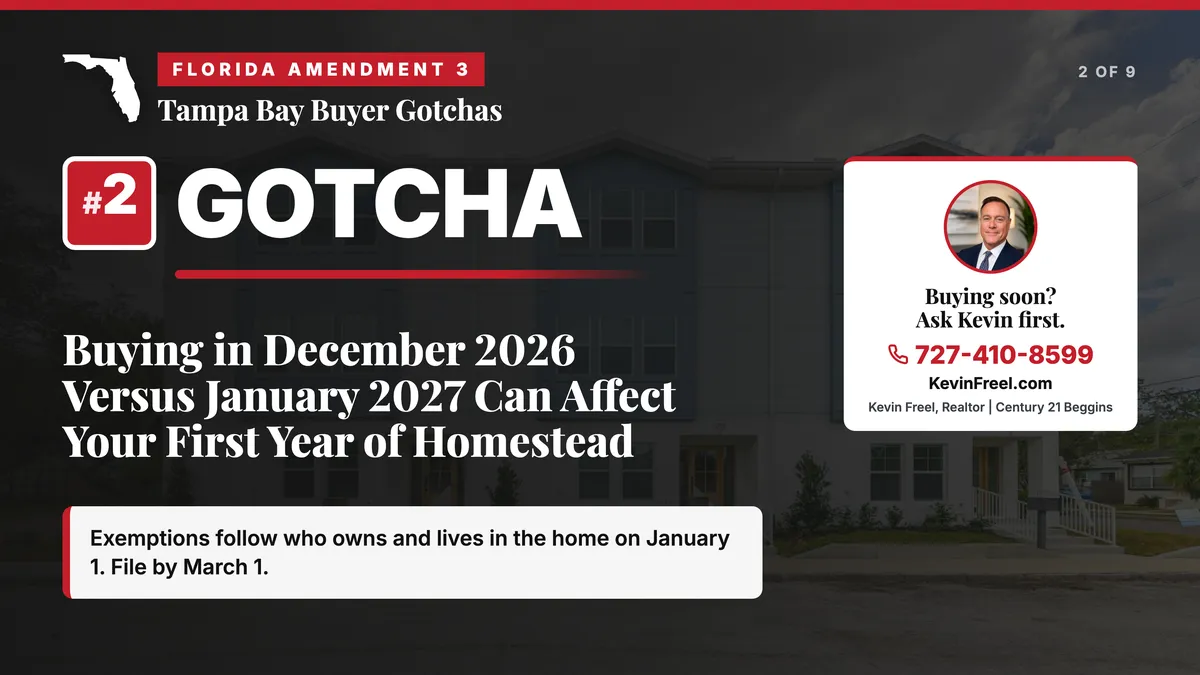
Florida property tax exemptions are generally determined by a property’s ownership and residency status on January 1 of the tax year.
That rule existed before Amendment 3, and it’s particularly important now.
If you purchase a home and establish it as your permanent residence by January 1, 2027, you may qualify for the homestead exemption for the 2027 tax year.
You must also apply by the regular March 1 filing deadline.
Here’s how that might work.
Scenario A: You Close in December 2026
You’re already a permanent Florida resident, or you establish your permanent Florida residency by December 31, 2026.
You close on a home in Tampa on December 20 and move in before the end of the year.
Assuming you satisfy the remaining homestead requirements, you could qualify for the new $150,000 non-school exemption in 2027.
Scenario B: You Close in February 2027
You’ve lived in Florida for years, but you purchase your home in February 2027.
Because you did not own that property on January 1, 2027, your own homestead exemption generally cannot begin until the 2028 tax year.
However, because you were a Florida resident before the December 31, 2026 cutoff, you may qualify for the expanded $250,000 exemption when your homestead begins in 2028.
The home’s existing 2027 tax status is a separate consideration, which I’ll explain next.
Scenario C: You Move From Out of State in 2027
You relocate from another state and purchase a primary residence in Tampa Bay in June 2027.
You generally cannot establish your own homestead exemption on that property until 2028.
And because you weren’t a Florida resident by December 31, 2026, the amendment provides the smaller exemption initially.
Under the five-year provision, if 2028 is your first qualifying homestead year, your fifth year would be 2032.
That could mean several years of higher property taxes compared with a similarly situated homeowner who met the residency cutoff.
The five-year provision is subject to federal constitutional limitations and future implementation details, so buyers should verify their eligibility rather than assume a particular outcome.
My advice? If you’re shopping for a Tampa Bay home near the end of 2026, understand how your closing date and residency status affect your taxes. But don’t rush into the wrong home simply to beat a deadline.
A tax benefit is only one part of a much larger financial decision.
Gotcha #3: Buying in 2027 Doesn’t Automatically Mean Paying the Full Property Tax Bill
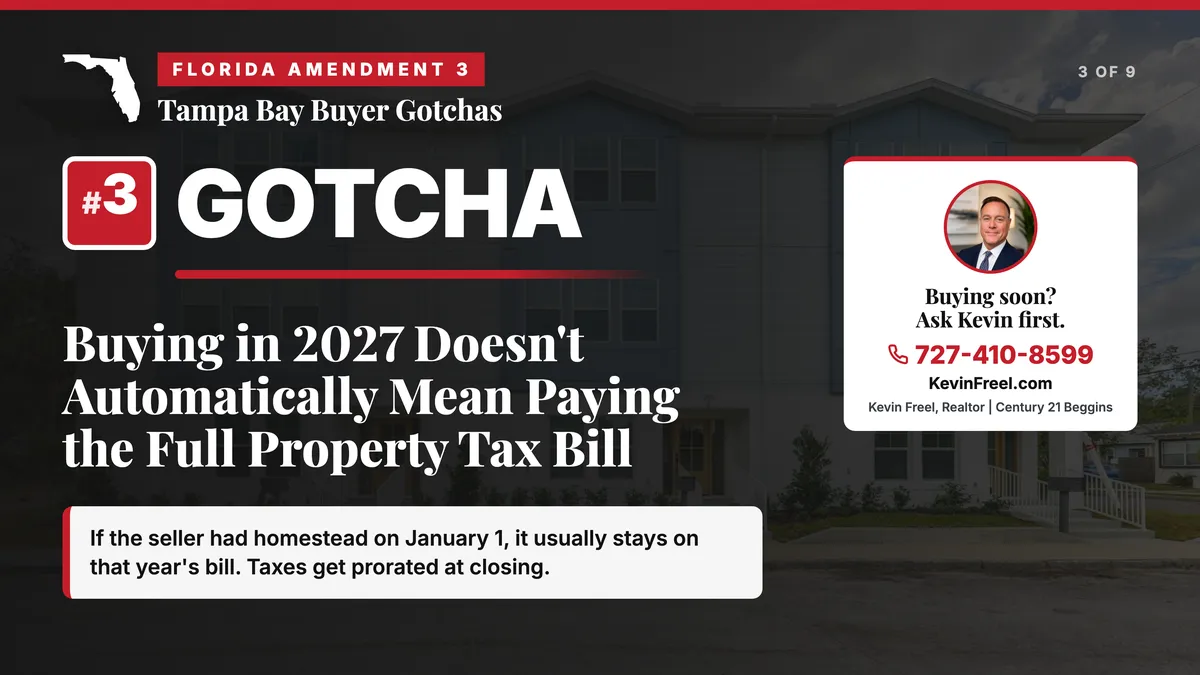
Here’s where Florida’s existing tax system can be confusing.
Let’s say you purchase a home in Hyde Park in June 2027.
The seller has owned that property for 20 years and has a homestead exemption.
You might assume that because you personally don’t qualify for homestead on January 1, 2027, you’ll immediately owe taxes without any exemption for the remainder of that year.
That’s not necessarily what happens.
Florida generally determines property tax exemptions based on January 1 ownership and residency. If a property was homesteaded by the seller on January 1, that exemption typically remains reflected in the property’s tax calculation for the entire year, even when the home sells.
But the exemption belongs to the seller. It doesn’t transfer to you as a permanent benefit.
When you close, the title company will typically prorate the year’s property taxes between you and the seller according to the contract.
Because Florida generally bills property taxes in November for the current calendar year, closing statements often use an estimate to divide that obligation.
The bigger concern can come the following year.
When the property is reassessed and your own homestead eligibility is established, your taxes may look very different.
Don’t confuse the tax bill you inherit during the year of purchase with the tax bill you’ll owe after the property is reassessed.
That’s something I want buyers to understand before they get to the closing table.
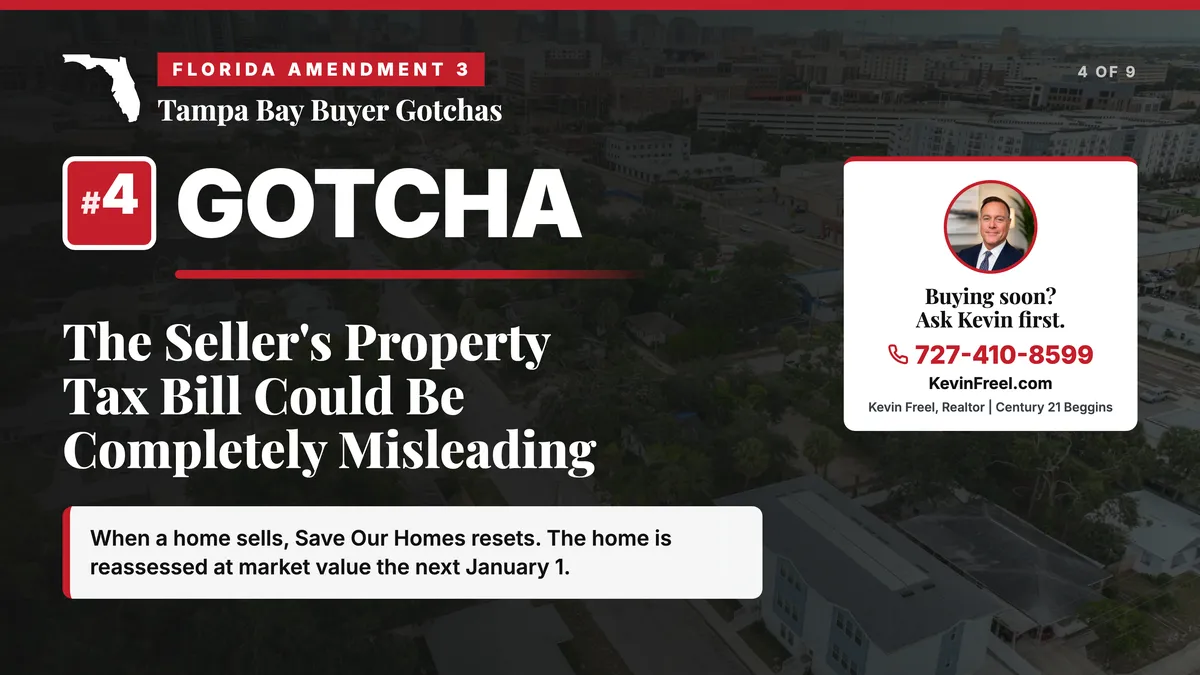
Gotcha #4: The Seller’s Property Tax Bill Could Be Completely Misleading
This is one of the most common property tax misunderstandings I see buyers make.
You find a beautiful home in Palma Ceia listed for $850,000.
The current owner’s property taxes look surprisingly low.
That’s great, right?
Maybe. But those taxes were calculated under the seller’s ownership history, assessed value, and exemptions.
If the seller purchased that home 25 years ago, their assessed value might be substantially lower than its current market value because of Florida’s Save Our Homes assessment limitation.
When ownership changes, that accumulated assessment limitation generally resets, and the home can be reassessed at its current just value on January 1 of the following year.
Amendment 3 provides a larger exemption, but it does not prevent this reassessment.
You could receive a larger homestead exemption while also having a higher assessed value than the previous owner.
Both can be true.
That means your property tax bill could increase even under a law designed to provide tax relief.
This is particularly relevant in established neighborhoods such as Hyde Park, Davis Islands, Beach Park, and Palma Ceia, where long-term ownership and rising property values can create a substantial difference between assessed and market values.
Before buying, get a property tax estimate based on your anticipated ownership, likely assessed value, and eligibility, not just the seller’s current tax bill.
If you’re just beginning your search, take a look at my Tampa Bay homebuyer’s guide. Understanding the financial details upfront makes the entire buying process easier.
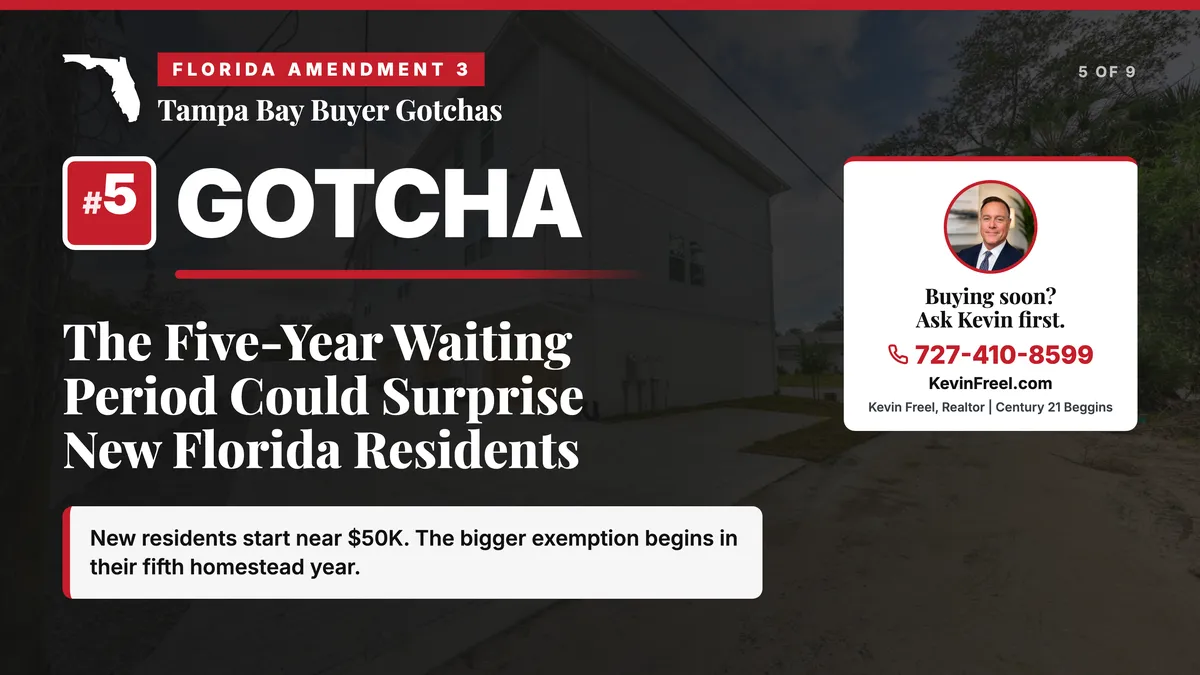
Gotcha #5: The Five-Year Waiting Period Could Surprise New Florida Residents
This is the provision I would pay particularly close attention to if you’re relocating to Tampa Bay.
People who were not permanent Florida residents by December 31, 2026, are treated differently under the new amendment.
They generally begin with an exemption of approximately $50,000 for non-school property taxes instead of the expanded $150,000 or $250,000 amounts.
The larger exemption becomes available beginning with the fifth year of their homestead exemption.
Notice something important.
The amendment refers to the fifth year of the homestead exemption, not simply the fifth anniversary of moving to Florida.
Those dates might not be the same.
For example, someone could move to Florida in 2027, rent for two years, and purchase their first home in 2029.
Their homestead eligibility would generally begin in 2030, assuming they meet the January 1 requirements.
Under the amendment’s five-year rule, the larger exemption would not become available until the fifth qualifying homestead year.
There is an additional provision allowing counties and municipalities, beginning in 2030, to shorten the waiting period under certain circumstances with a two-thirds vote of their governing bodies.
But that is not an automatic benefit.
The residency restriction also includes language requiring compliance with the U.S. Constitution. That means future court decisions or implementing legislation could affect how the rule operates.
For now, this is something relocating buyers should understand and verify when planning their budgets.
Gotcha #6: Your Property Tax Bill Isn’t Going Away

I’ve seen people interpret Amendment 3 as the elimination of property taxes on their primary homes.
That’s not what the amendment does.
Even with a $250,000 homestead exemption in 2028, homeowners may still owe:
- School district property taxes.
- Non-school property taxes on assessed value exceeding their applicable exemption.
- Non-ad valorem assessments, such as certain stormwater, waste collection, and special district charges.
- Community Development District (CDD) assessments, where applicable.
Those charges can vary quite a bit depending on the neighborhood.
A home in an established South Tampa neighborhood may have a very different set of assessments from a home in a newer planned community in Odessa or Lutz.
The amendment also does not eliminate homeowners insurance, flood insurance, HOA dues, or condominium association fees.
And for qualifying homeowners with assessed values of $250,000 or less in 2028, a zero non-school ad valorem tax liability doesn’t mean every item on the property tax bill disappears.
The important number isn’t just how much your exemption increases. It’s what your total annual cost of ownership looks like after everything is included.
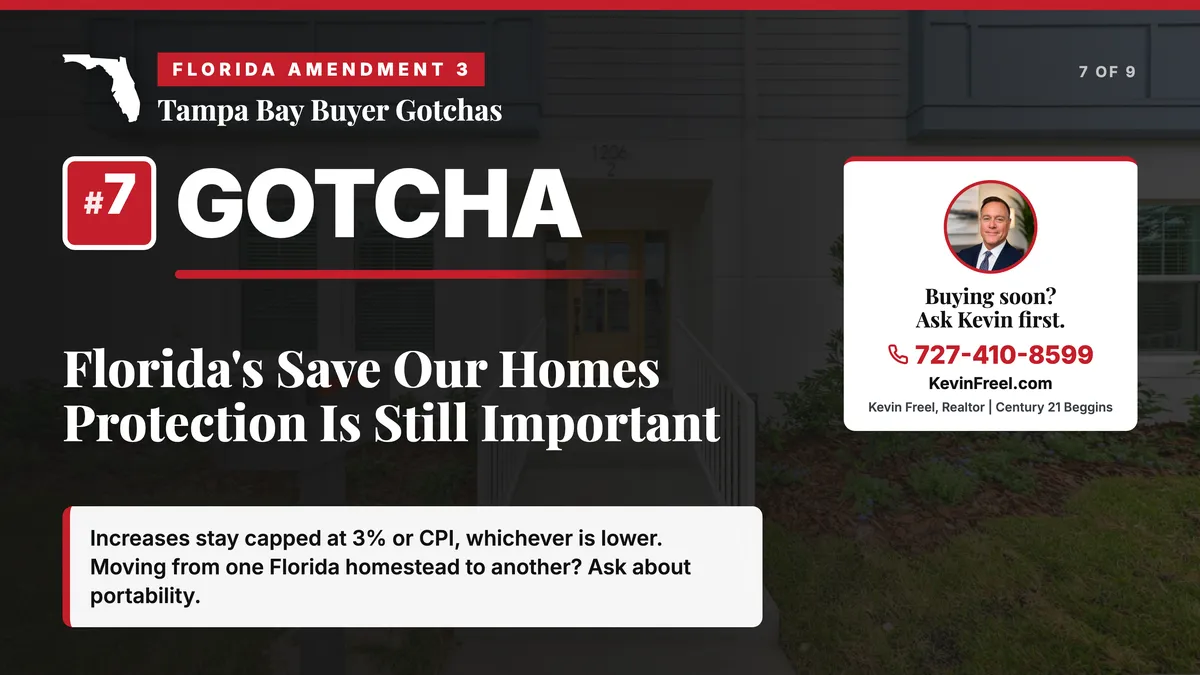
Gotcha #7: Florida’s Save Our Homes Protection Is Still Important
One piece of good news is that Amendment 3 does not eliminate Florida’s existing Save Our Homes assessment limitation.
For qualifying homestead properties, annual increases in assessed value are generally limited to the lower of 3% or the applicable Consumer Price Index change.
That’s valuable protection for homeowners who stay in their properties over time.
But remember, the protection doesn’t automatically carry over to the person buying the home.
If you’re selling one Florida homestead and purchasing another, you may qualify for something called portability.
Portability allows eligible homeowners to transfer some or all of their accumulated Save Our Homes assessment benefit to a new homestead, subject to the applicable rules and limits.
That’s separate from Amendment 3’s larger exemption.
You must apply for the new homestead and the portability benefit. They do not automatically transfer just because you buy another Florida property.
If you’re moving from Clearwater to South Tampa, or downsizing from a larger home in St. Petersburg to something smaller, portability could be an important part of your tax calculation.
It’s worth checking before you sell, not after you’ve already closed.
Gotcha #8: Rental Properties and Second Homes Get a Different Tax Benefit

Amendment 3 isn’t just about primary residences.
It also changes the assessment limitation for non-homestead properties.
Previously, qualifying non-homestead properties had a 10% annual cap on increases in assessed value for non-school taxes.
Beginning in 2027, Amendment 3 reduces that cap to 5%.
This affects property types such as rental homes, second homes, and commercial real estate.
For Tampa Bay property investors, that could provide additional protection from increases in assessed value.
However, there are two important distinctions.
First, the 5% limit applies to increases in assessed value, not necessarily the annual tax bill. Changes in property tax rates can still affect what you owe.
Second, a change in ownership can trigger reassessment. The cap does not necessarily protect a newly purchased investment property from being assessed at its current market value.
For someone buying a vacation property near Clearwater Beach or a rental investment in St. Petersburg, the treatment is different from a primary homestead residence.
Make sure your calculations reflect the actual use of the property.
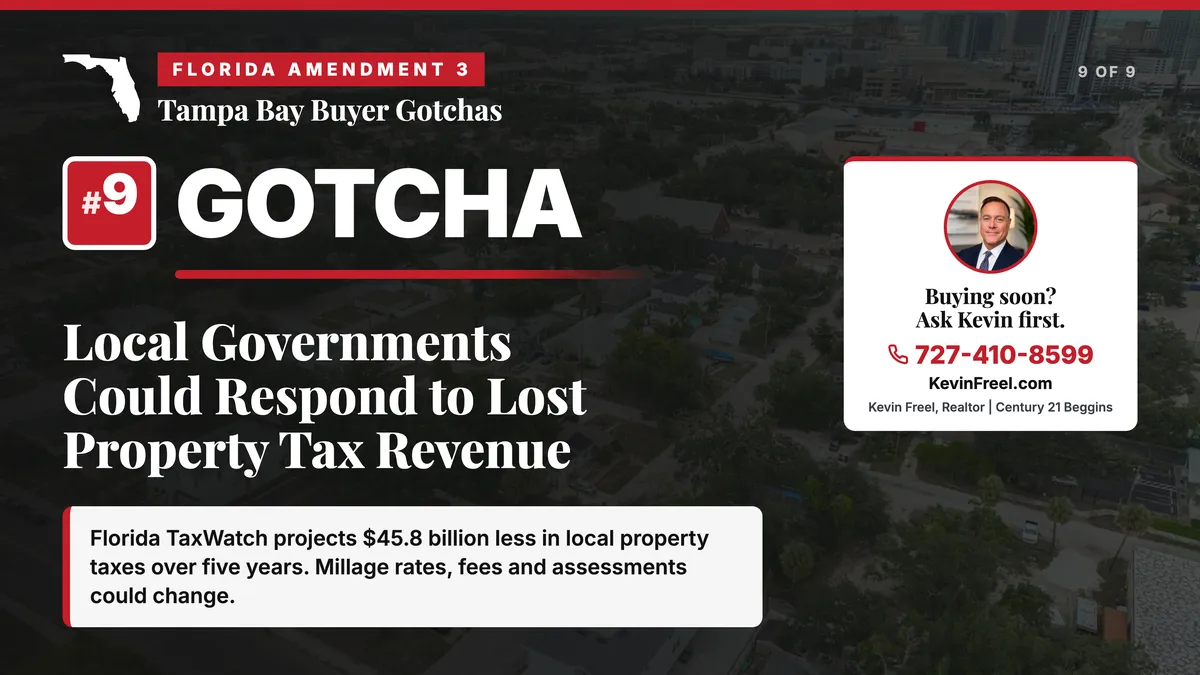
Gotcha #9: Local Governments Could Respond to Lost Property Tax Revenue
There’s another side of Amendment 3 that homeowners should understand.
Property taxes help pay for local government services, including public safety, infrastructure, parks, libraries, and other community needs.
The statewide increase in exemptions will significantly reduce the property tax revenue available to counties, cities, and special districts.
Estimates from Florida TaxWatch, based on state revenue projections, put the potential reduction at approximately $45.8 billion statewide over five fiscal years.
That’s a substantial amount of money.
Here in Tampa Bay, Hillsborough and Pinellas counties, local municipalities, and special districts will have to account for the changing revenue picture.
Local governments may consider budget changes, adjustments to millage rates, or changes in other fees and assessments.
That doesn’t automatically mean specific public services will be eliminated or that every homeowner’s tax rates will increase.
It does mean the financial implications extend beyond the individual homeowner’s exemption.
And while the amendment describes permitted uses of county and municipal property tax revenue, it also allows additional spending approved by local governing authorities, subject to state law.
The rules are more nuanced than simply eliminating funding for everything outside public safety and infrastructure.
For homeowners, the practical takeaway is this:
A larger exemption doesn’t guarantee that every other tax, fee, or assessment will remain unchanged.
What I Would Tell Anyone Buying a Tampa Bay Home in 2026 or 2027
There is a lot to like about a larger homestead exemption, particularly for long-term Florida residents.
But if you’re getting ready to purchase a home, I would focus less on the headlines and more on the details that affect your specific property.
Before closing, here’s what I’d want you to know:
- Your permanent Florida residency date. Were you a permanent resident by December 31, 2026? This could determine when you qualify for the expanded exemption.
- Your closing and occupancy dates. Will you meet the January 1 ownership and permanent-residence requirements for the applicable tax year?
- The property’s current exemption status. Does the seller have a homestead exemption, and how will that affect the taxes for the year you close?
- Your estimated taxes after reassessment. Don’t rely on the seller’s tax bill. Ask for an estimate based on the property’s anticipated new assessed value.
- Whether you qualify for portability. If you already own a Florida homestead, you may be able to preserve a valuable assessment benefit.
- The rest of the property tax bill. Look at school taxes, special assessments, and other local charges rather than focusing only on the new exemption.
For official details, you can review the Florida Legislature’s Amendment 3 summary. Your county property appraiser should also be part of your research, particularly while implementation guidance is being finalized.
Is It Better to Buy a Tampa Bay Home Before the End of 2026?
That’s a question worth asking, but the answer depends on your situation.
If you’re already a Florida resident and can establish a qualifying homestead before January 1, 2027, purchasing before the end of 2026 may allow you to receive the expanded exemption a year earlier.
If you’re moving to Florida from another state, establishing permanent residency before December 31, 2026, may also have important implications under the amendment’s residency provisions.
But I wouldn’t tell anyone to buy a home just because there’s a tax deadline approaching.
Location, condition, insurance costs, financing, and long-term affordability all matter.
A home that’s right for your family five or ten years from now is more important than chasing one year’s tax savings.
What I would encourage you to do is get the right information before you make a decision.
I’ve spent more than 40 years helping buyers and sellers throughout Tampa Bay, and knowing what questions to ask can make a tremendous difference.
Whether you’re looking at a bungalow in Hyde Park, a waterfront property in St. Petersburg, a home in Clearwater, or something in Odessa or Lutz, the numbers need to make sense for you.
You can begin exploring available properties through my Tampa Bay home search.
The Bottom Line on Florida Amendment 3
Florida Amendment 3 creates an opportunity for meaningful property tax relief, especially for established Florida residents who qualify for the larger homestead exemption.
But there are several details worth remembering.
- The December 31, 2026 residency cutoff is important.
- January 1 determines annual homestead eligibility.
- Buying in 2027 doesn’t necessarily mean you’ll lose the seller’s existing exemption for the entire year, but you generally won’t qualify for your own new homestead until 2028.
- New Florida residents face different rules, and buyers should never assume the taxes advertised on a listing are the taxes they’ll pay after purchasing the property.
- And perhaps most importantly, Amendment 3 doesn’t eliminate all property taxes.
I’ve always believed buying a home should come with a clear understanding of what you’re getting into, financially and otherwise.
The best surprises in real estate are finding the perfect home, not receiving an unexpected tax bill.
Let’s Talk About Your Next Move
If you’re planning to buy or sell a home in South Tampa or anywhere throughout the Tampa Bay area, I’d be happy to help you work through the numbers and understand the questions to ask before closing.
I can help you evaluate properties, compare neighborhoods, and coordinate with the right professionals to get accurate information about taxes, insurance, financing, and the closing process.
Kevin Freel | CENTURY 21 Beggins
Call or Text: (727) 410-8599
Email: KevinFreel@c21be.com
Contact Kevin Freel
Property tax rules, eligibility determinations, and implementing guidance can change. This article reflects the amendment approved November 3, 2026, and existing Florida homestead procedures. Confirm your individual eligibility and estimated tax obligations with the appropriate county property appraiser and qualified tax or legal professional.